
The Ring Super Bowl Ad: Interview with the CEO
The seven ingredients of a perfect-storm corporate crisis

The most talked-about Super Bowl ad last week wasn’t for beer, or cars, or Doritos. It was for a new feature of the Ring video doorbell:
The ad introduces Search Party, a Ring feature that uses AI to help find lost dogs.
The 30-second, $8 million ad was supposed to make viewers feel warm and fuzzy about Ring. That is not quite what happened.

And it wasn’t just headlines. It was Reddit. It was Congress. (“This is definitely not about dogs—this is about mass surveillance,” posted Democratic Senator Ed Markey.) It was social media. I’ll let this tweet represent thousands like it:

And no wonder. 78 percent of Americans have home security cameras, tens of millions of them made by Ring. It sure looked like they were now being turned into a dystopian nationwide surveillance system, à la “1984.”
The same thought hit almost everyone simultaneously:
Inc: “Today, Ring is looking for dogs. But…expanding what—or who—that system can be used to find is not a major technical leap.”
The Ringer: “Footage from its cameras could be turned over to law enforcement agencies, including ICE.”
ACLU: “That power may be applied to puppies today, but where else might it be applied? Searches for people wearing t-shirts with certain political messages on them?”
Ring’s ad backfired in a Biblical way, and the company is still dealing with the fallout—which includes people ripping out and smashing their Ring cameras…on camera.
The CEO Responds
Jamie Siminoff, Ring CEO and the inventor of the product, spent a few days in New York this week, making TV and New York Times appearances on a sort of apology/explanation tour. (In the ad, that’s him talking. That’s also his dog.)
I met with him on Monday. I wanted to ask him what went wrong, how he couldn’t have anticipated the crisis, and what’s going to happen next.
I’ll say this for him: He does not come across like a slick tech bro. He may be rich (he sold Ring to Amazon in 2018 for $1.15 billion), but he’s stumbly in his speech, a self-admitted ADHD guy, and quick to admit his own blunders. (The title of his self-deprecating, self-published memoir is “Ding Dong.”)
And he did not see the Search Party controversy coming.
“We announced it in September,” he says. “We sent out multiple emails to our base of tens of millions of customers. We didn’t hide this thing—like, the opposite! We were banging pots outside of our window on this! And—nothing.” No pushback, no controversy.
The feature worked, too. In the first 90 days, over 100 Ring customers got their dogs back, including a veteran whose specially trained PTSD dog jumped the fence.
“And then the Super Bowl ad hit, and it just—it hit people’s imagination. People are scared of AI right now, and it just took off.”
Siminoff considers the backlash misinformed. In particular, he bristles at one aspect of the online narrative: Its implication that our Ring cameras are being hijacked by a vast, involuntary surveillance network, in which we are unwitting pawns.
“I do think that this is definitely an overreaction,” Siminoff says, “and that the people that are overreacting to it don’t necessarily know how it’s working.”
In fact, Ring does not send footage to anyone—dogs or otherwise. You must manually share any relevant video clips, one at a time.
In Search Party, for example, one of your neighbors uploads a photo of the lost dog. Ring’s AI software studies the breed, size, fur pattern, markings, and the time and place of the dog’s escape. Then, if your Ring camera spots a match, the app lets you know. (Lost dogs, Siminoff says, are by far the most common posts on the Ring Neighbors tab, which is a sort of neighborhood news feed.)
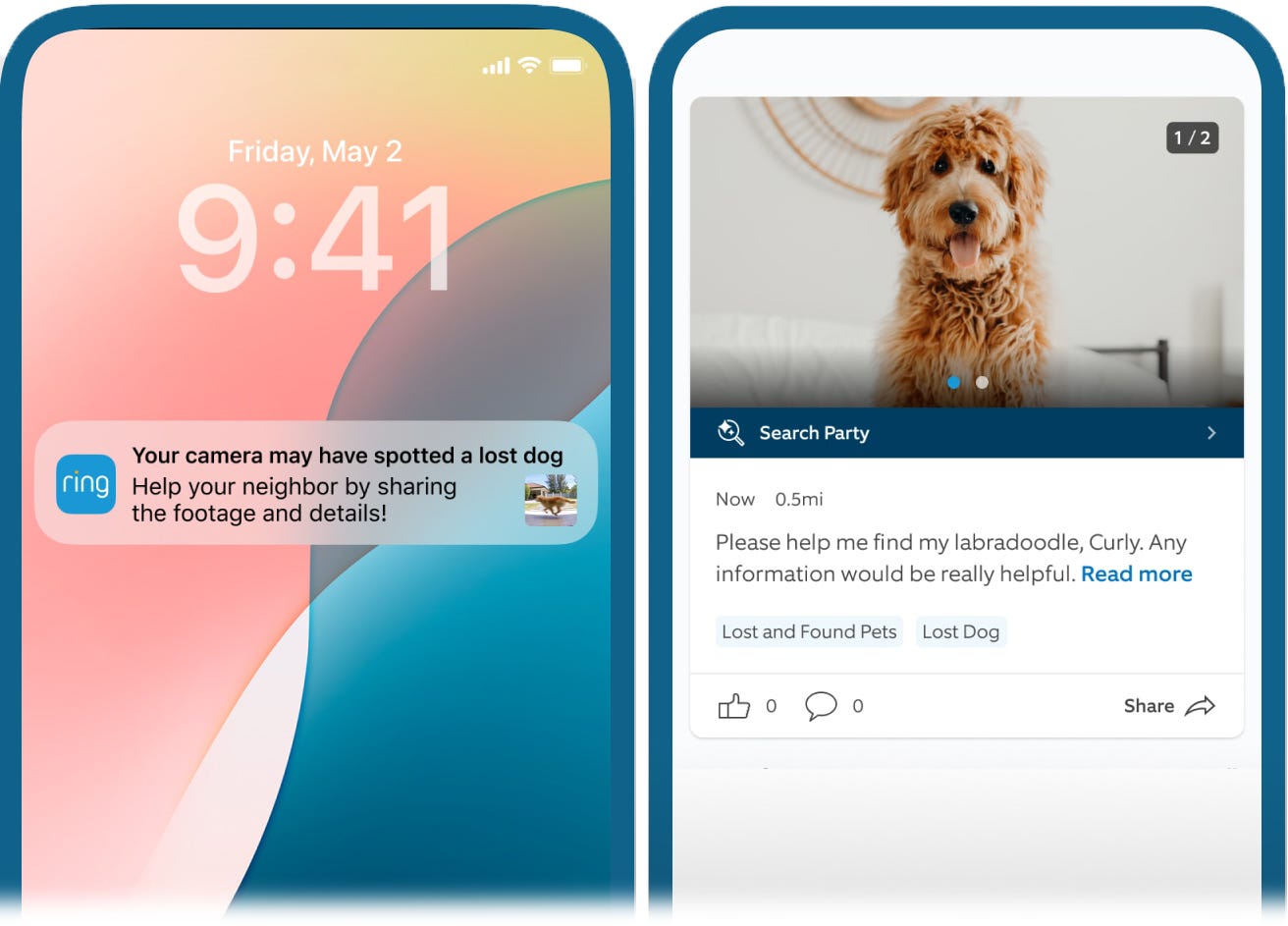
At that point, the app shows you the clip that your camera took, the one that seems to match the lost pet.
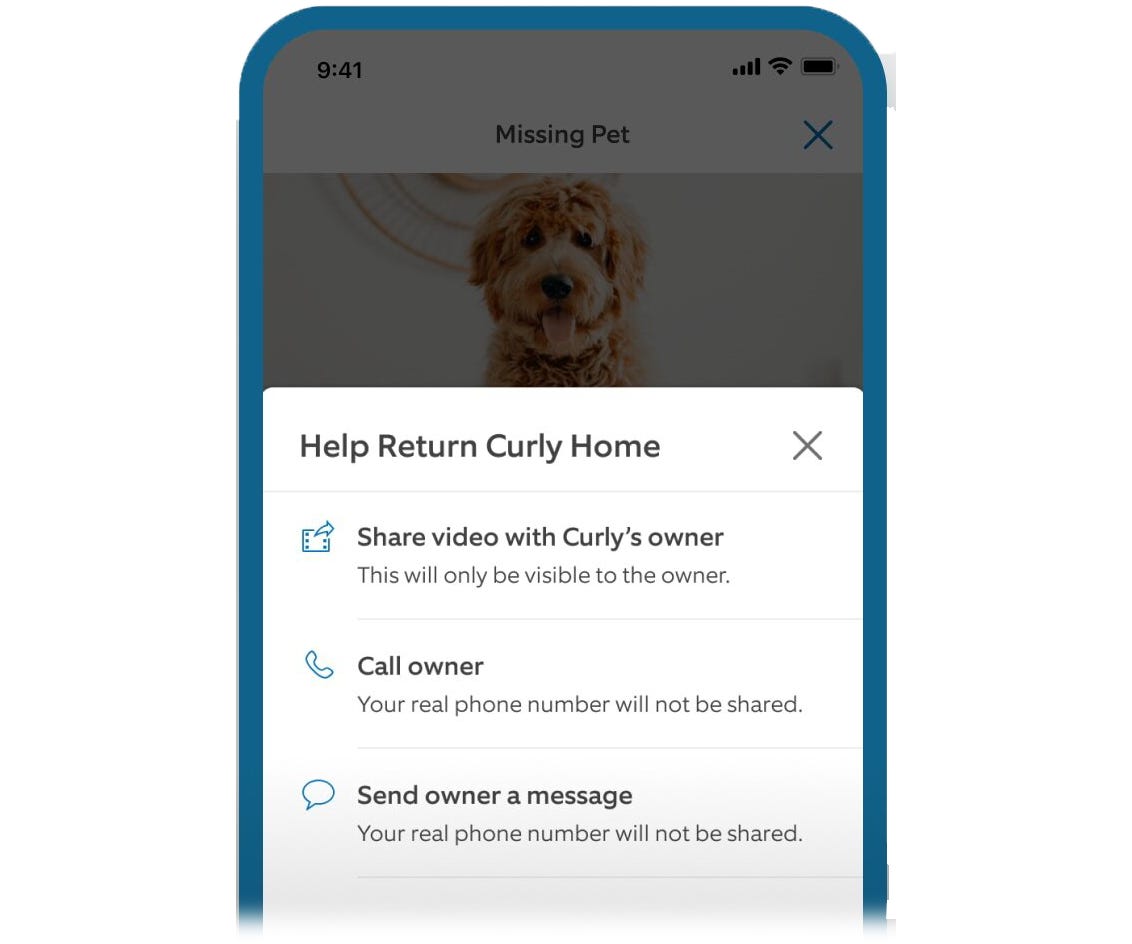
You can choose to send the video clip, call the owners, message them—or do nothing.
Siminoff can’t understand why anything that is so under your control could have whipped the public into such a frenzy.
Seven Ingredients of a Perfect Storm
The elements of Ring’s crisis could fill every square on the PR disaster Bingo card. Here are its seven ingredients—including the ones that Ring bought on itself.
Factor 1: The timing
A couple of years ago, Search Party would probably not have screamed “mass government surveillance.”
What’s changed, of course, is ICE.
Today, millions of people are on edge, having watched government forces break into homes without warrants, use AI facial recognition to track their targets, and shoot U.S. citizens. No matter what your political beliefs, this is something new—and, for many people, terrifying.
Here’s what Siminoff says on the ICE issue.
POGUE: There’s a lot of speculation about your involvement with ICE.
SIMINOFF: Zero.
POGUE: You’ve got no relationship?
SIMINOFF: No. No connection, no relationship.
POGUE: You don’t feed any data—?
SIMINOFF: Never have.
POGUE: Other federal agencies?
SIMINOFF: No.
Factor 2: The graphic
This animated graphic appears 15 seconds into the ad:
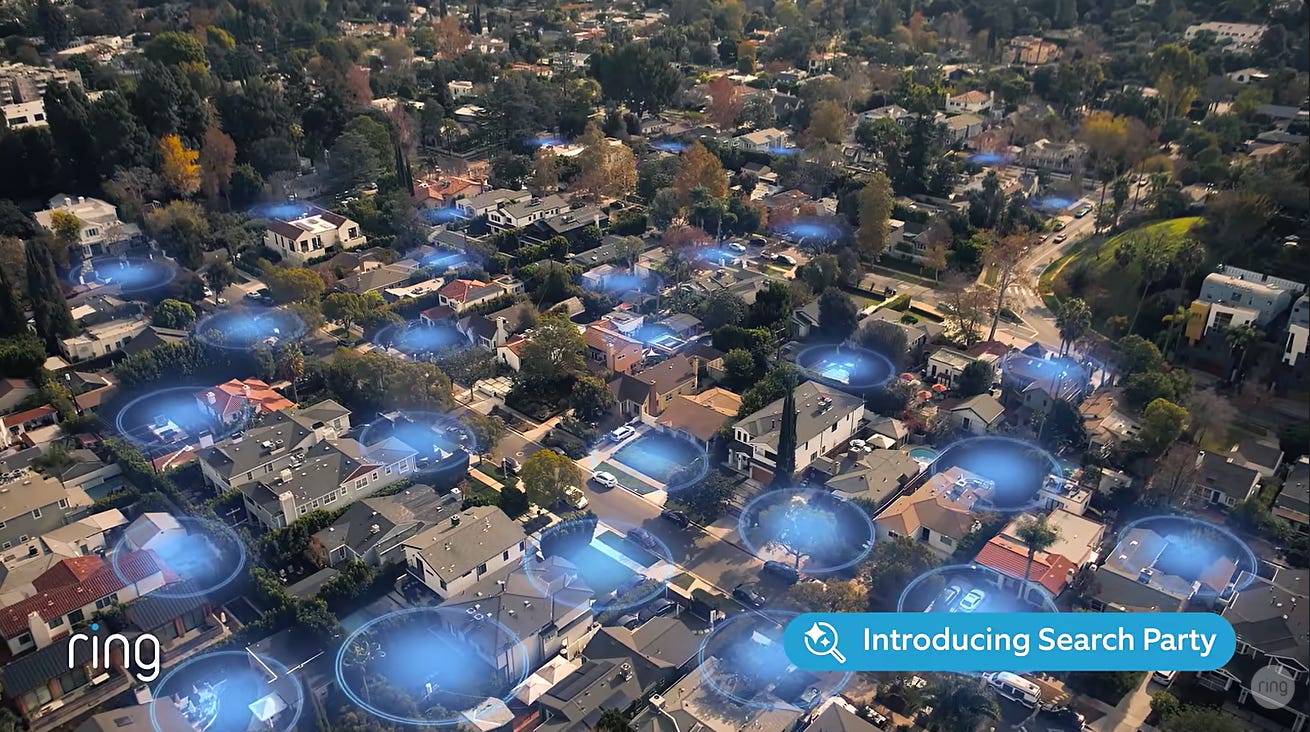
Nothing screams “mass surveillance” like Skynet beams shooting out of every house.
“Yeah,” sighs Siminoff. “When you look at it through to what happened post-[Super Bowl], I would’ve changed that part. Like, that part of the ad would’ve said, ‘As a Ring customer, you get an alert, and you get to choose to contact them or not.’ I would’ve used that same moment to do that.”
Factor 3: The terminology
Ring seemed to have been oblivious to the triggering qualities of a term like “Search Party.”
Search parties hunt down people. The feature should have been called Puppy Patrol, or maybe Fido Finder.
Factor 4: Conflation with “Community Requests”
Ring does offer a feature that’s meant to find people.
Ring has relationships with 2,000 local police departments, in which police can send out a sort of digital “Wanted” poster. It’s a way for your local police department to request the public’s help finding a perp. It’s a notification that lists the time, place, and details of a crime, along with the contact information of the detective.
This feature is called Community Requests. (Another dumb name. These are requests made by your local police department, not by the community. How about “Detective Quest”?)
If you want to help out, the app can show you all the videos your camera caught during the specified time period. You look them over, and if you find one that you think would be useful to the investigation, you can forward it to the local police. It’s all manual. No AI or face recognition is involved. It’s a glorified tip line.
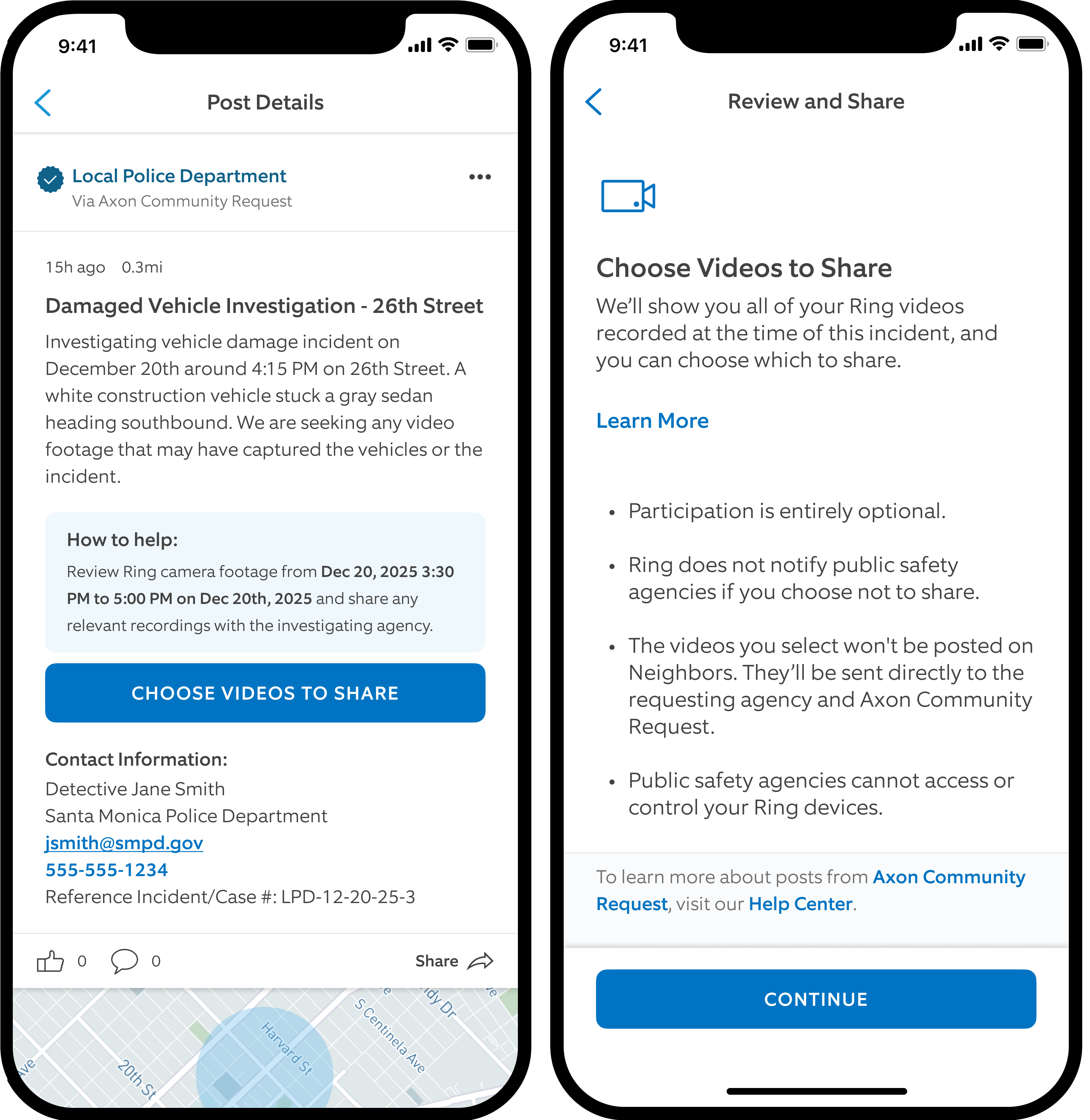
Police routinely use Community Requests to catch porch pirates (package-stealers) and car thieves. In 2022, this feature helped convict a 28-year-old who murdered four college kids. Community Requests also helped to catch the Brown University /MIT shooter.
It’s also playing a role in the search for Nancy Guthrie, although the area is too rural for it to have much success. “The Guthrie case is kinda sadder for us because of the way the homes are there,” says Siminoff. “There’s just very few cameras to the street. The houses are super spread out.”
Community Requests are public. You can see a list of them here, including active ones.
But here’s where things get complicated. The Ring ad has become a litmus test for how people feel about law-enforcement technology in general.
Are you OK with fingerprinting and DNA labs? How about digital forensics like cellphone tracking? What about drones? Or security videos sent in by neighbors? Where do you draw the line?
“If something bad happens in a neighborhood,” Siminoff says, “do we not want people to be able to share it, as long as it’s their choice?”
Factor 5: The Flock deal
The Flock deal is dead, but lots of people don’t seem to know it. (“Ring shares data with Flock, whom sells data to ICE,” EytanMorgentern posted on Reddit. “Welcome to policed mass surveillance state style monitoring.”)
Flock, a $7.5 billion tech company that serves police departments, is explicitly a surveillance company. Its primary business is selling license plate-reading cameras—about 6,000 police departments own them—and police drones. Flock insists that it never shares its footage with ICE—but local police departments can and do.
Last fall, Ring announced a partnership with Flock to help administer Community Requests, verifying, logging, and creating an audit trail for the requests. Which meant that the footage you submit from your cameras could, in theory, indirectly, wind up in ICE’s hands.
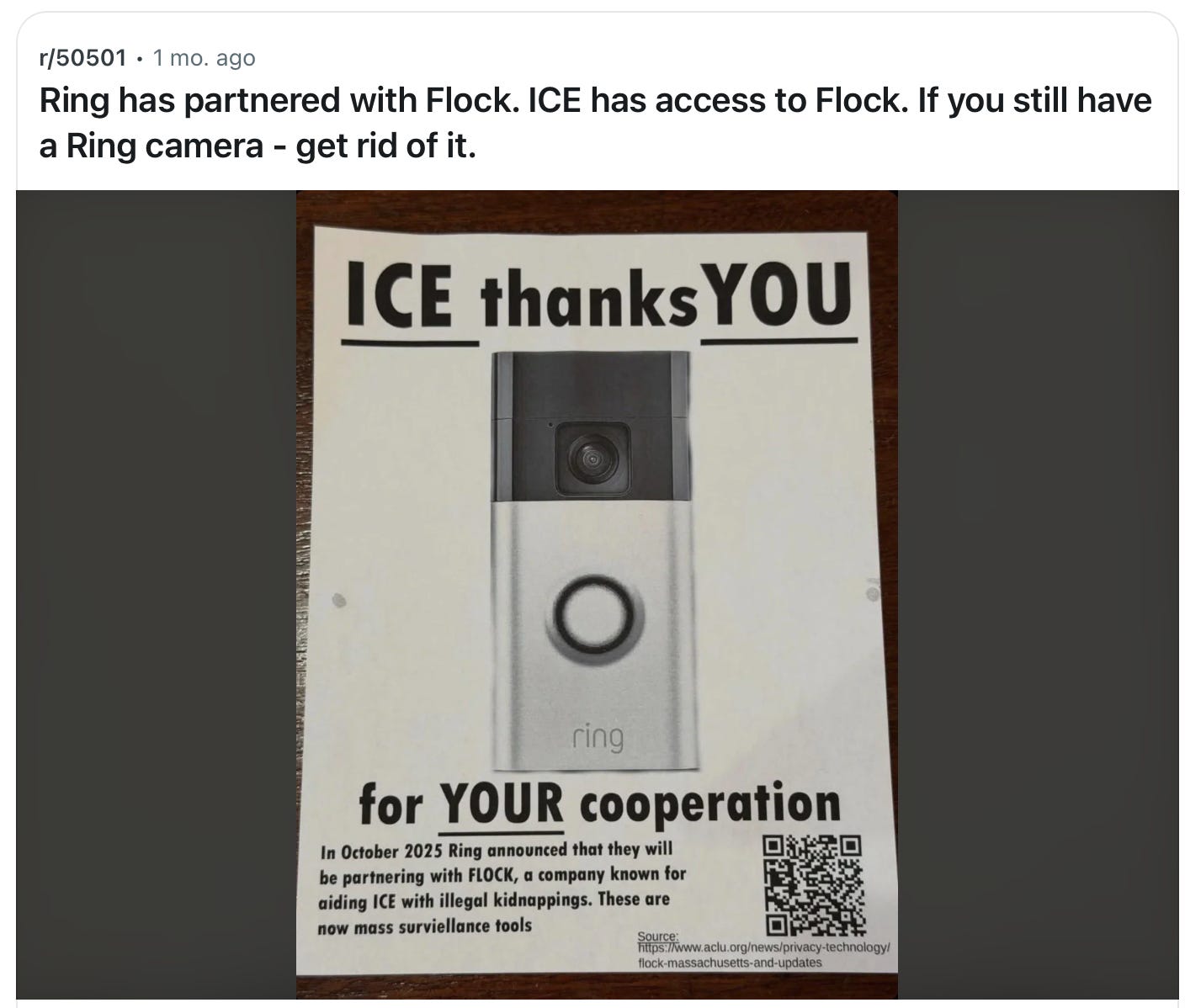
Four days after the Super Bowl outcry, Ring canceled the proposed partnership. It hadn’t yet started. No videos were ever shared. But clearly, plenty of reputational damage had already been done.
Ring still works, however, with a company called Axon (the taser maker) to administer Community Requests. “No money trades hands,” Siminoff says. “It’s a pro bono commitment.”
(And why is Axon involved? “In the first version of this, we would literally have to go to police departments directly and sign them up. Like, Captain Whatever had to have a login. Axon already works with police departments, so Axon can guarantee the request. So it does let us step back. I think it’s actually a good thing—the church and state thing.”)
There are two situations, by the way, when your footage may be provided to police without your volunteering it.
First: If police have a search warrant. (This is not unique to Ring; it’s the law.)
Second: If there’s an emergency, “literally like a murderer in the house kind of thing. It has to be active, something where it’s actually life or death.” Siminoff says that these situations are very rare, but won’t say how rare.
Factor 6: The Nest controversy
Just when you thought the whirling emotions couldn’t get any more heightened:
Nancy Guthrie’s house had a doorbell cam from Nest (Ring’s rival, owned by Google). Unfortunately, she wasn’t paying for a subscription, which is required if you want your camera’s footage saved.
Fortunately, Google’s engineers somehow retrieved footage of the kidnapper anyway.
What the hell—? Google could access footage even from a disabled account? It’s technical, but yes. When it comes to these companies earning our trust, this is not helping.
If she’d had a Ring camera, no footage would have been recoverable. Siminoff says that when you delete videos from a Ring account, they’re gone; a script overwrites them instantly.
So wait—given the Guthrie episode, is that a good thing or a bad thing?
Factor 7: Ring’s track record
Ring hasn’t exactly spent its first 13 years building trust. In 2023, for example, the FTC accused the company of allowing employees and contractors to access customers’ video recordings, including one employee who spent months watching videos of female customers in their homes. (Ring settled for $5.8 million and changed its security protocols, but did not admit to all the charges.)
Opting Out
If you have a Ring camera, you don’t have to rip it out of your wall and smash it. If you don’t want to participate in Search Party and Community Requests, you can turn them off.
Search Party. In the Ring app, tap the three-line menu (top left). Tap Control Center -> Search Party. Turn off “Search for Lost Pets” and/or “Natural Hazards (Fire Watch).” Or just don’t send in any videos.
Community Requests. You’re never part of the program until you explicitly choose a video and send it. If you want to turn off notifications of police requests, from the three-line menu (top left), tap Control Center -> Public Safety. Turn off “Community Requests Email Notifications.”
You can also encrypt your Ring videos, end to end, so that nobody can have them but you—not law enforcement, not Ring, not ever. Instructions are here. Note, however, that encryption means losing a long list of features, including video preview alerts and the ability to share video clips with anyone.
You can also get a security camera that stores your footage on memory cards, right in the camera, instead of online. (Here’s Wyze’s mean, hilarious parody of Ring's ad, making that point.) The downside, of course, is that if the bad guy smashes or steals the camera, as the Guthrie kidnapper did, you lose all your footage.
Nothing’s ever simple.
Next Steps
Siminoff fervently believes that people’s concerns—that his cameras could one day be used to hunt down non-criminals like immigrants, political enemies, and activists—ought to evaporate once they understand how the programs work. That Ring doesn’t hand over videos; you do.
“It’s your camera. It’s your data. You’re controlling it,” he says. “Ring’s not doing this collectively across everything. It’s up to you to make decisions.”
He’s asking us to trust that things will remain that way, in an age when trust in big tech is harder and harder to muster.
In the meantime, Siminoff says that he’s learned from the episode. “You take the scrutiny to help make you better,” he says.
Still, he has no intention of shutting down Search Party and Community Requests; he believes too much in the power of these cameras to make neighborhoods safer. He remains convinced that Ring can harness these millions of cameras for the greater good, without sinking into Big Brother Land. “It’s our job to show you that you can control your privacy, you can have your security, you can control your video—and also when something happens, help the neighborhood. Both things can be true.”
In fact, he’s toyed with adding a Search Party-like feature to help find missing children and wandering dementia patients (Silver Alerts). It would work the same way: You’d be offered the chance to help, and if you liked, you’d be able to choose relevant video sightings to send to the worried families.
“There’s—I forget the number of Silver Alerts a year [note: it’s about 2,500], where someone gets lost in a neighborhood,” he says. “And so, you could see how a Silver Alert makes sense especially in places like Minnesota, where it’s cold, where it actually gets dangerous.
“But we are not at all actively working on it. And the first thing we have to do is think about, like, what are the unintended consequences?”
Good job David. Danny Kahnman’s “Thinking, Fast and Slow” came to mind when the ad blew up. Your article clearly shows Senator Markey’s response was pure Fast Thinking. The irony is the Senate is supposed to be comprised of Slow Thinkers who serve as a breakwater on the passions that ebb and flow in a republic.
David I love your writing and what you do for CBS Sunday morning. Maybe it’s because I’m Canadian ( who happened to be in the US at the time of the SuperBowl to see all the adds — doesn’t happen up in Toronto) and as a dog owner I had a totally different reaction — I thought what Ring was doing was brilliant. I wouldn’t mind losing my husband but my DOG!!! Well that’s a different matter. Thanks for interview — provided a great deal of insight into the CEO— I rather like him.