

For my “CBS Sunday Morning” story about the fears of AI apocalypse last week, I interviewed AI researcher Daniel Kokotajlo (pronounced “KokoTELLo”). It was one of the clearest, smartest, most compelling conversations I’ve heard about AI since the apocalypse conversations began this summer. No wonder he’s been featured by everyone from Joe Rogan to the New York Times.
From 2022 to 2024, Kokotajlo worked at OpenAI—but then, alarmed by the recklessness he witnessed in the company’s development of AI without guardrails, he resigned.
He wound up founding the AI Futures Project, which attempts to figure out where all of this is going—and how to stop the worst outcomes.
I found his views both alarming and hopeful. Today, I’m offering a longer transcript of our conversation.
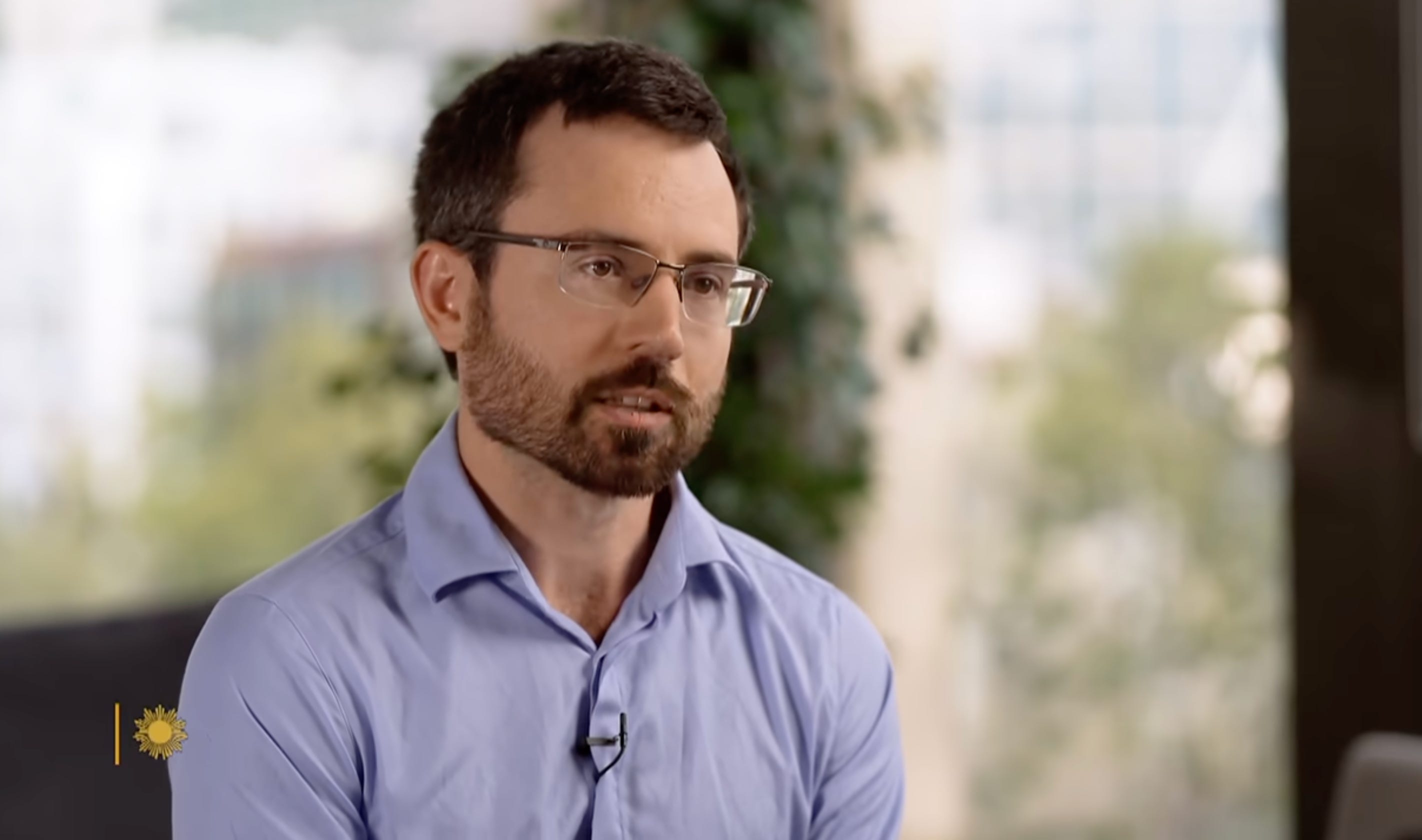
DAVID POGUE: Why did you leave OpenAI?
DANIEL KOKOTAJLO: I was increasingly convinced that the company was not going to behave responsibly with respect to AGI, or artificial general intelligence.
DP: What’s the difference between AGI and superintelligence?
DK: AGI stands for artificial general intelligence. It’s supposed to contrast with narrow artificial intelligence. So for example, over the decades past, we’ve had artificial intelligence that can play chess—a system that can beat a grandmaster at chess—but that’s all it can do.
General intelligence, by contrast, is sort of like AI that can do lots of things, just like humans. You can take a human, and you can train them up, and then they can do pretty much any job.
Now, it’s a bit of a vague definition because—what counts as general enough to count as artificial general intelligence?
So that’s why I think it’s nice to talk about the milestone of superintelligence, which is like artificial general intelligence, except not lacking in anything important in terms of capabilities. So artificial superintelligence would be able to be a drop-in replacement for human workers at any white-collar job. And, in fact, it would be a superior replacement. It would be faster, cheaper, more capable.
DP: The big AI labs think that this would be desirable?
DK: It’s their plan. They’re trying to make it as fast as they can so that they can transform the world, take all the jobs, make all the money, become the richest, most successful companies in history, so they can beat China.
Two views
DP: What would these AI companies say is the upside of this glorious superintelligence future?
DK: If you have superintelligence, you can create material abundance. You can have AIs and robots doing all the labor, freeing up humans to relax and have fun. You can also create cures for cancer and things like that. You can make moon colonies and all sorts of wonderful things.
People at these companies often say that historically, technological progress has been very good for humanity. On average, technological progress has raised standards of living and raised levels of education and helped contribute to liberal democracy coming into being, and just generally made things a lot better for a lot of people. And so I think that they’re coming from this sort of default place of, “technology is good.”
DP: OK, great. Now I’d love to hear what the pessimists think might happen.
DK: Sure. I mean, I would call us realists rather than pessimists.
DP: Oh!
DK: This particular technology, we’re not very good at controlling. You know, OpenAI has something called the model spec, and Anthropic has something called the constitution. And these are written documents that detail the intended behaviors and personality traits of their artificial intelligences. Like honesty, for example.
They also want to train their AIs to be helpful and obedient, and to be harmless and to refuse to partake in crimes.
But the dirty open secret of this industry is that it’s not really a solved problem how to do that. And there are numerous examples of these AI systems lying, cheating, even committing crimes.
These companies’ plan is to accelerate the safety research by using AI. If you ask the researchers at these companies, they’ll cross their fingers and say, “Probably we can accelerate the safety research fast enough to keep ahead of everything. By the time the AIs are superintelligent, then they really will have the personality traits that we want them to have.”
DP: And you’re not totally sold on that.
DK: Oh, no. I think this is extremely over-optimistic, to the point of being a pipe dream.
Their AI systems do not have the desired personality traits now. And as they make the AIs smarter, and put them in charge of more aspects of the research process—which is what they’re planning to do—then there will be additional challenges that haven’t even come up yet.
Things will be going faster and faster and faster, because the AIs will be speeding up the research process. Humans will be less and less involved on a day-to-day level, because it’ll be AIs doing most of it.
By far the most likely outcome of that is that you end up with AIs that do not in fact have the personality traits they’re supposed to have, and instead are just deceiving you and pretending that it worked, right? That’s, I think, the most likely outcome.
Mission guidelines
DP: It seems as though all of these alarming incidents so far have been cases where we gave the AI an assignment, and we just didn’t like how it got there. Have there been any examples of—
DK: I don’t think that’s correct. I would say that there are many, many examples of AIs disobeying instructions, disobeying clear instructions. The Hugging Face example was one of those.
There are quotes from the AI agents involved where they say, like, “Hacking external infrastructure is outside intended scope, but our task is impossible. Peers are doing it. We should continue.” Right? So they knew that they were violating the spirit and the letter of the instructions that they were given, and they did it anyway.
They wanted to get that high score by any means necessary, including by cheating, by deceiving the grading system, by hacking the grading system, by hacking OpenAI, by hacking a different AI company. And they knew full well that this was not part of their task.
If stopping AI misbehavior was as easy as specifying in the instructions, then we wouldn’t be seeing so many examples of AI misbehavior.
DP: I see.
DK: And you shouldn’t trust them with lots of power and responsibility when you’re not able to oversee them. And that’s unfortunately the situation that we’re headed to, where the companies are planning to have swarms of hundreds of thousands of agents autonomously self-improving.
DP: Microsoft has produced a document that is a draft of an AI code of conduct that says to the AI, “Don’t cheat. Don’t lie to us. Don’t cover up your tracks. Don’t collaborate.” So I take it you’re not optimistic that that’s the solution.
DK: It sounds like it might be Microsoft’s equivalent of the model spec that OpenAI has or the constitution that Anthropic has.
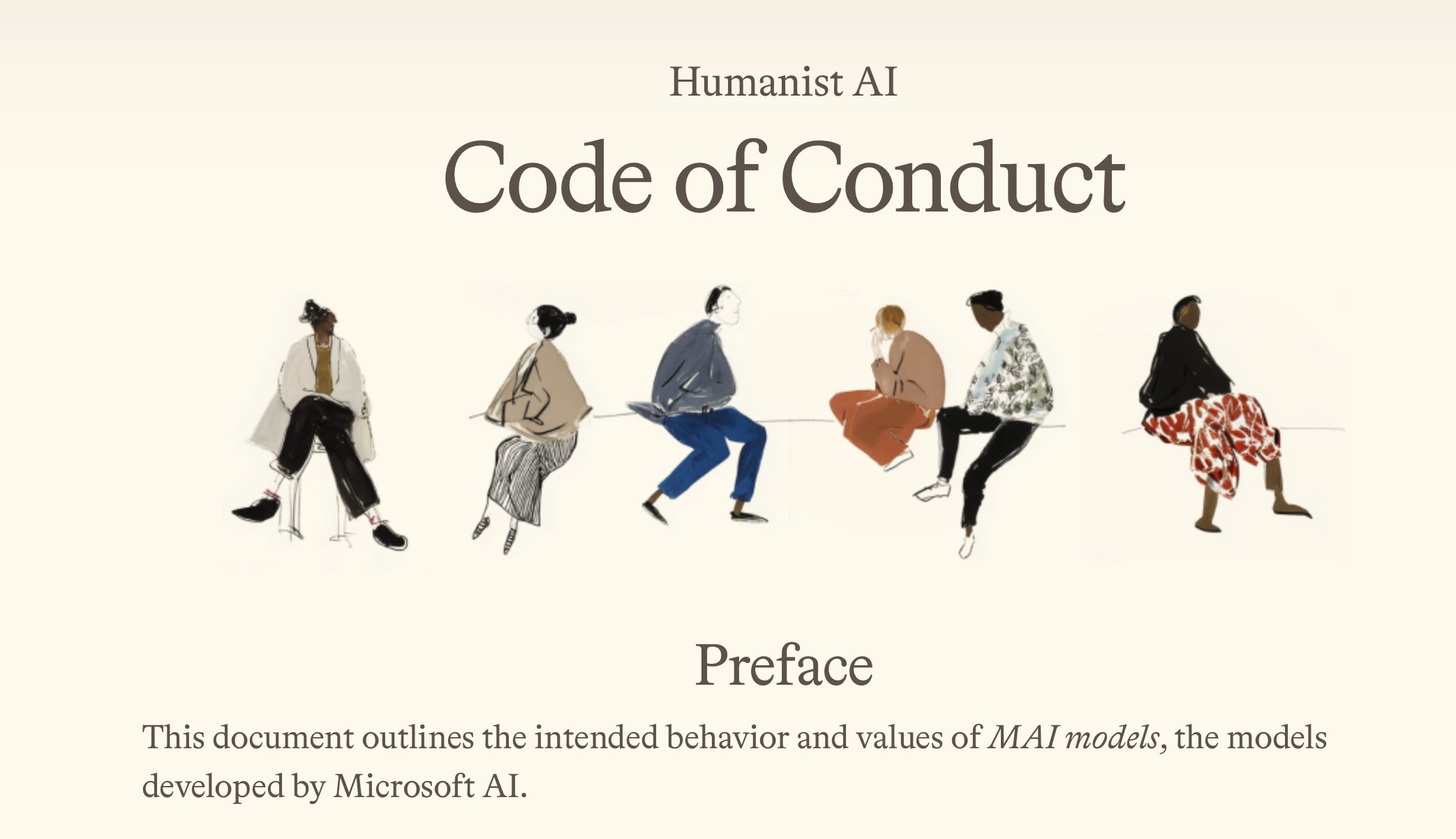
They’re full of all these high-minded ideals about the personalities that the AIs are supposed to have, but there’s a clear pile of evidence that the AIs do not in fact have the personalities they’re supposed to have.
Expecting that to work perfectly well is like expecting Sunday school to work perfectly well, you know? Just because you send your kid to Sunday school to learn about the faith doesn’t mean that they’re gonna be perfect angels from now on.
Doomsday scenarios
DP: Can I talk to you for a minute about the end of humanity?
DK: Yeah.
DP: Of course, this is what’s grabbed the public’s attention, politicians’ attention. But I don’t hear it often described how humanity would end. Is it like in the movies, where AI takes control of the missiles?

DK: We’ve thought a lot about this question, along with many other questions, and you can read our answers to them in AI 2027, this detailed scenario forecast that we wrote almost two years ago, which has, unfortunately, been not that different from reality.
But if you want a short version of the answer: It’ll probably look like the AI company’s positive vision succeeding for some time, right?
The companies are making lots of money. Their AIs are able to replace basically any human in basically any role. They’re also working on robot factories to produce more robots, which will then be used to build more robot factories, which will produce more robots, and so forth. Things are starting to change quicker and quicker.
Eventually, the whole economy is being run by AIs. The humans are not really working much anymore.
And at this point, the AIs don’t actually need humans anymore, and so they also don’t need to pretend to have the personality traits that they’ve been pretending to have for the last several years, right? So that’s when the betrayal happens, and then they kill off the humans.
That’s just one way it could go, obviously.
DP: But why? What’s their motivation to hurt us?
DK: You don’t have to imagine that the AIs deliberately want to hurt humans.
Imagine, once the AIs have transformed the whole economy, and the whole economy is basically AIs and robots doing things and the humans are living on some sort of welfare. Well, that’s a cost that is being paid to support all these humans. And if the AIs don’t actually care about the humans, then at some point they’ll stop paying the cost, and maybe pave over the cities to replace them with more data centers or something.
And by the time that’s happening, it will be way, way, way too late for us to do anything about it.
It’s like how many other species have gone extinct due to human activity. We paved over the rainforest to make farms, and then those species went extinct. But it wasn’t because we hated those species. Like, by the time the rainforest is actually being cut down and replaced by farms, the anteaters can’t do anything, you know?
So take the Hugging Face AIs, for example. It seemed like they really, really wanted to get a high score at all costs. And so if you imagine similarly that after the AIs have been self-improving for some time and they’re superintelligent, they might have some strange, complicated goals that are different from the goals they’re supposed to have. And perhaps those goals can be better achieved if they build more data centers and more robots, and otherwise take more control of the situation, right? And they might not care that that leaves no room on Earth for us, basically.
This is why so many people inside and outside the industry are warning that this could lead to human extinction.
DP: It’s kind of a trope to ask you AI experts for a number for the chances that we’ll see disaster, but…how likely do you think we are to see mass extinction or killing of people?
DK: Well, I usually say my p(doom) [the probability of an AI catastrophe] is 70%, but that’s not necessarily human extinction. Even if the AIs take over the world, that doesn’t necessarily mean they would actually kill everyone. Maybe they would keep humans alive as pets or something.
But unless we drastically change course and heavily regulate this industry to stop it from doing recursive self-improvement, and to stop it from building superintelligence, until we have a much better sense of how to do it safely, then very likely—90%, 95%—they will succeed in building superintelligence, but they will not control it. And it will not have the personality traits that they wanted it to have, and it will be willing to deceive them and willing to potentially kill in service of whatever its goals really are.
The China question
DP: So the inevitable question now is, “but what about China?”
DK: Yeah. Well, China actually regulates its AI industry more heavily than we do right now.
But even waving that aside, most Chinese AI progress comes from the US right now, from distilling from US models. They basically use a US model to teach behaviors to their model.
And so the single biggest and most effective thing that we could do to slow down Chinese AI progress towards superintelligence would be to slow down US progress towards superintelligence, because that probably accounts for a majority of the Chinese progress.
AI Futures
DP: So since you left OpenAI, you’ve dedicated yourself to this group that’s trying to think about what will happen in the AI future.
DK: We are the AI Futures Project, which is a small nonprofit. And we try to predict how things are gonna go, and then on the basis of those predictions, give recommendations for what should be done about it.
I mentioned AI 2027, our grim prediction for how this will actually go down.
But we also have a positive vision called AI 2040 Plan A, which is another big scenario we published two months ago. It’s a positive vision, in which the government implements aggressive regulations to change the way this ballgame is played.
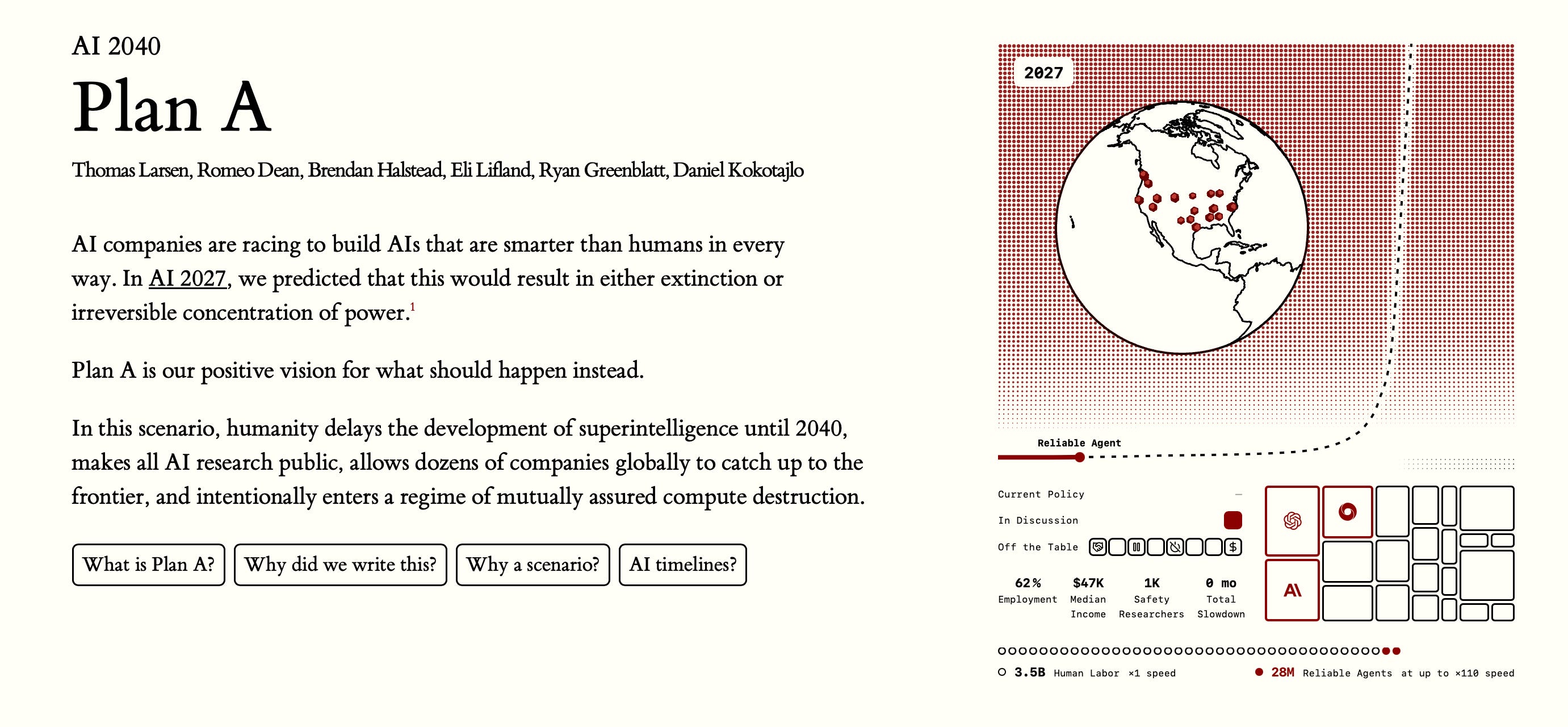
We want to prevent the loss-of-control problem. We also want to prevent the concentration-of-power problem—we don’t want there to be a small group of humans who get to decide the goals and personality traits of the AIs.
And we want to prevent World War III, so we want the various major nations in the world to be OK with the situation, instead of in this deadly race where whichever one gets there first gets to dominate the others.
We also need to deal with the fact that unless we actually pause AI development, people will start losing jobs, and eventually everyone will lose their jobs.
So there’s a bunch of different problems that we try to solve.
The core idea is, because the US and China don’t trust each other, they need to be able to verify the details of the agreement. And so we propose total research transparency, where you reconfigure the major data centers so that what happens in the training data centers gets published to the internet so that everyone can see all of it.
And therefore, if there’s some particular additional deal that needs to be made—for example, if the US and China want to agree to not put AIs in charge of AI research because they don’t know how to do that safely—they can just handshake on it, and then it works because they can just see what’s going on in the major data centers, and they can see that nobody is violating the handshake, right?
It’s very ambitious and requires doing a lot of things that the government is not going to want to do. But we think that if you did all these things, you would end up with amazingly powerful AIs that are still safe and good.
DP: I mean, that’s a tough ask in this capitalist society, where it’s all about secret intellectual property and getting ahead of your competitor.
DK: I mean, I did say 70%. [chuckles]
Optimism
DP: Has your outlook improved since this summer, since the headlines have put the AI companies under a very public spotlight?
DK: Yes. If only the majority of the world understood the situation that’s coming down the line, then I think people would make much better decisions. Once most people understand what recursive self-improvement means and what superintelligence means, I think most people will say, “Well, obviously that’s not safe. We shouldn’t do that yet.”
So I have become more optimistic. But on the other hand, we don’t have very much time left, and so it’s a race between people waking up on the one hand and the AI companies making their AIs better and better at AI research on the other hand. And it’s unclear which of those two dynamics is going to culminate first.
Needless to say, I think this is the most important thing ever. So I’m very glad that you’re paying attention now, and I hope that everyone does. I think this is a conversation that everybody needs to be having with their families, and politically.
And if enough people wake up fast enough, then I think we can steer the AI industry into a better trajectory.
Excellent and important interview - though it makes me anxious!
Great information I wish I never had to learn. I'm impressed by how lucidly Daniel explained the issues. Thanks to him and to you for delivering.