

Please see a total solar eclipse before you die. Please.
There is no experience like it, and no way to understand it through photos or videos.
The sky takes on a silvery-gray, shimmery quality, deepening to indigo at the moment of truth. The stars come out. The air temperature plummets ten degrees.
Suddenly it’s nighttime in the middle of the day. The wind picks up; streetlights come on. The sounds of birds and dogs vanish as they settle in for the night, probably confused.
And where the sun should be, there’s now a laser-cut hole in the sky. Around it: the corona, a blazingly intense halo of the sun’s outer atmosphere.
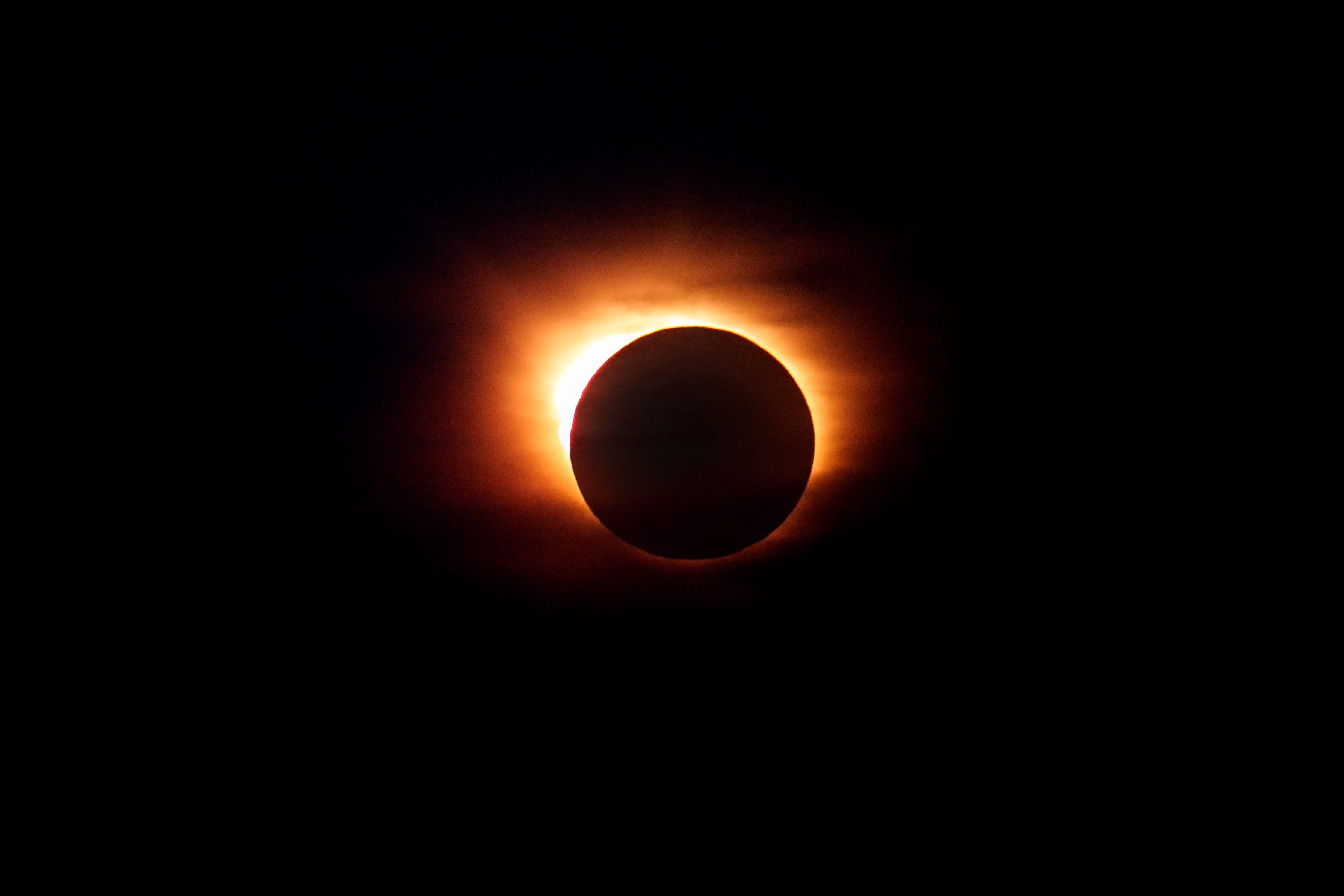
My photo here, I’m sorry to say, lies. Most Google eclipse image searches lie, too. They show a black ball against a black sky, and that is not it at all. In fact, the sky is a surreal indigo/blue. It’s an intense white corona against an intense glowing blue sky. No camera ever made can capture the range of light you see in person.
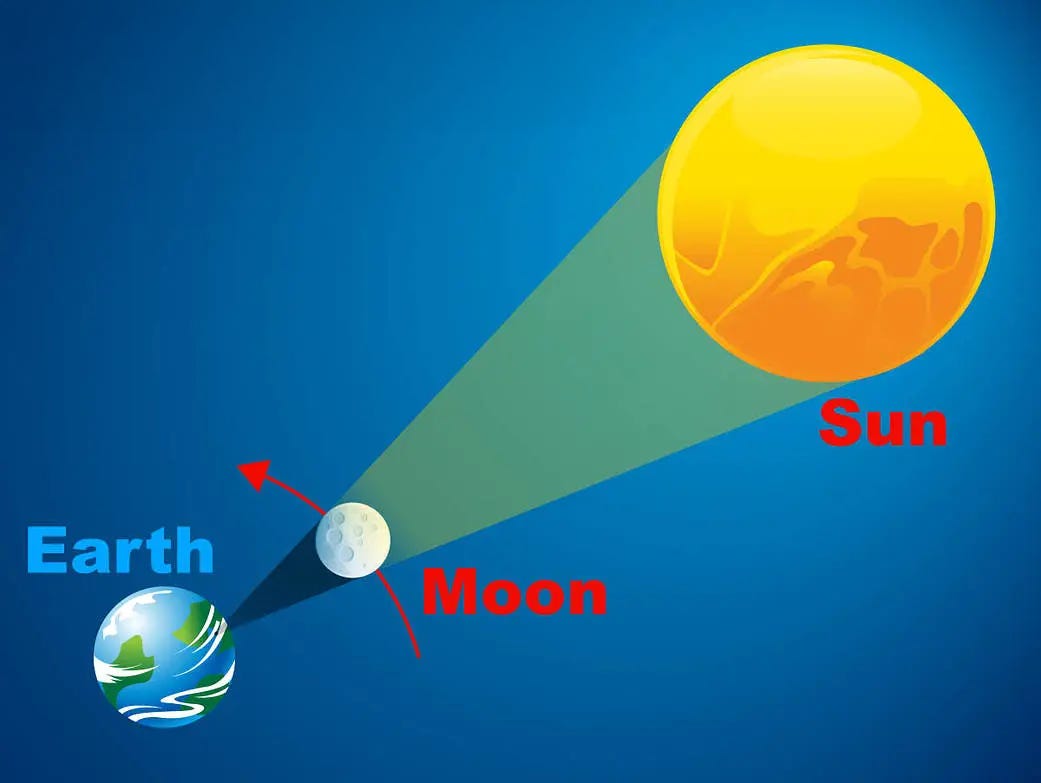
Through a freakish coincidence, the moon happens to be exactly the right size and distance to cover the sun perfectly. The sun is 400 times as big as the moon, but also 400 times farther away.
If we didn’t know the science of it, we’d be just as terrified as the ancient people were. It all looks deeply wrong. (Here’s my “CBS Sunday Morning” story from 2024.)
“You feel something in the pit of your stomach like something is wrong in the day, something is not right,” retired NASA astrophysicist Fred Espenak told Time. “As totality begins, and the shadow sweeps over you, the hairs on the back of your neck and arms stand up.”
The journey
I’d taken my kids to watch the U.S. eclipses in 2017 and 2024—and apparently turned at least one of them into an eclipse chaser. My 21-year-old son Jeffrey, working in Berlin for the summer, suggested a father-son bonding trip to see last week’s eclipse in Spain.
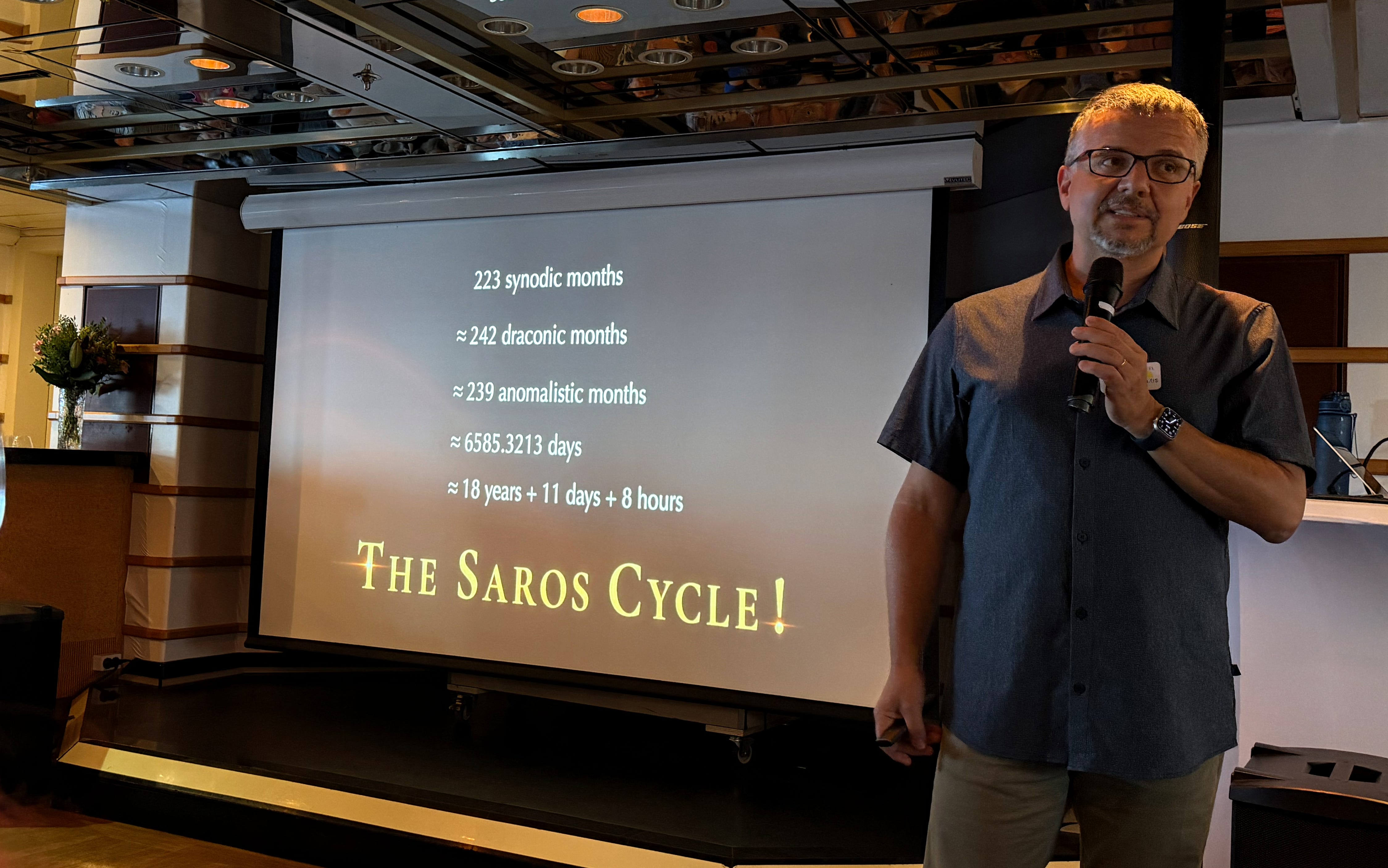
We joined a cruise organized by Scientific American. (It’s the longest-running magazine in America, founded in 1845.) It made sense: First, I’d been a SciAm columnist for eight years. Second, the cruise would be guided by three astronomers, plus the magazine’s space and physics editor. They would be giving talks and teaching us what to look for.
An eclipse at sea offers pros and cons. On one hand, you miss out on the freakish silence of the animals, the sudden emergence of insect sounds, and the sudden rush of wind in the trees.
On the other hand, the most heartbreaking aspect of eclipse chasing is the risk of clouds. And in theory, if clouds were predicted for one part of the Mediterranean, our captain could move the ship.
Being at sea also meant that we could avoid the crushing crowds, the hours in traffic, and the inflated lodging prices that accompany an eclipse on land.
Finally, with luck, we’d enjoy ocean breezes. Europe, as you may have heard, is in the middle of a brutal, relentless heat wave. Our ship, leading up to the eclipse, spent the week visiting four scenic ports, for our sightseeing pleasure: Nice, Barcelona, Menorca, and Mallorca. Jeffrey and I saw some spectacular sights and learned a lot. But we were also outside all day, and holy god: The heat, on a continent where air conditioning is not yet standard, was absolutely punishing.
Rarity
Total solar eclipses are rare: only about 70 eclipses every century, many of them over the sea where nobody sees them.
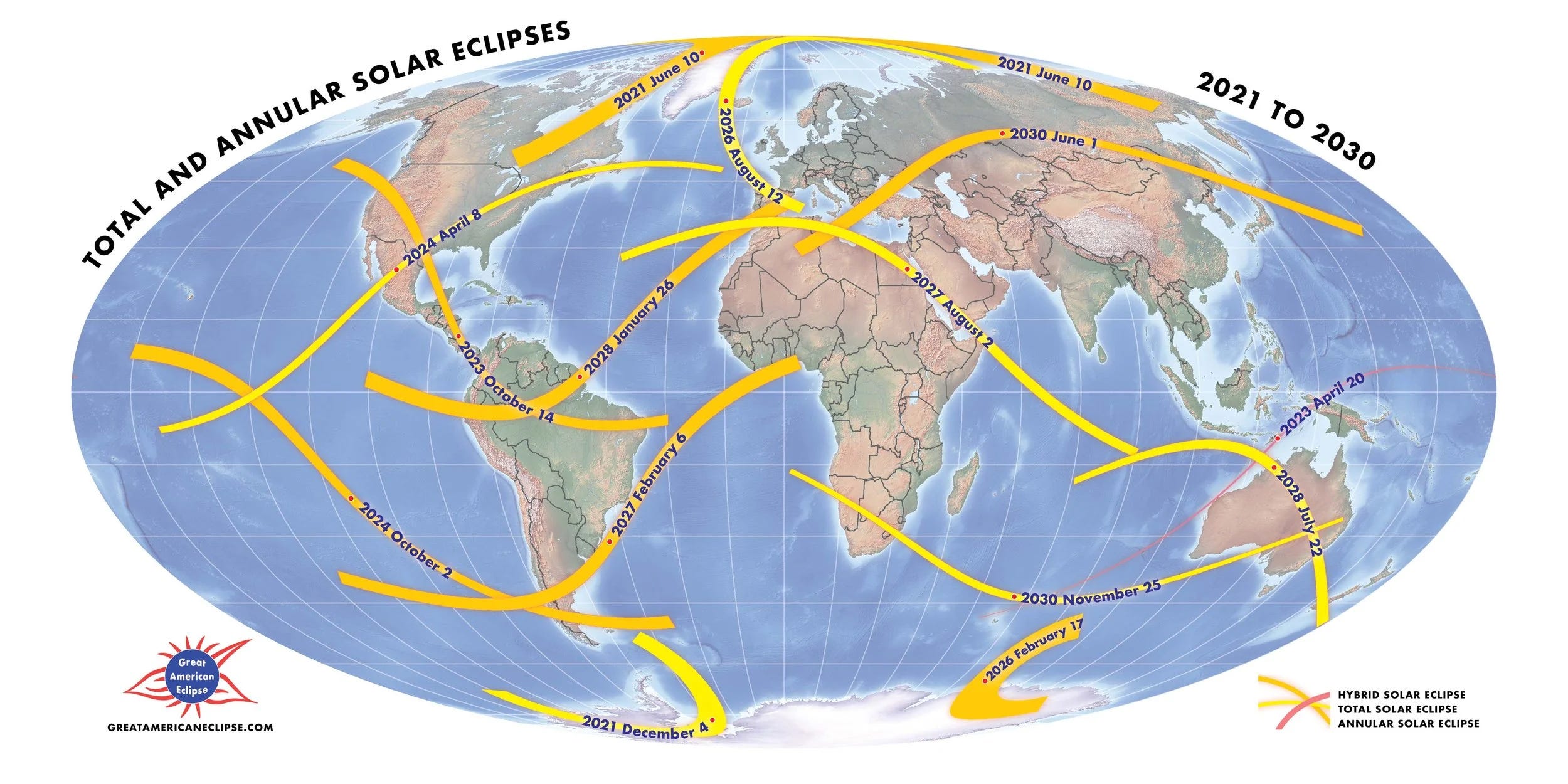
Furthermore, you get the full experience only if you’re within the narrow path of the moon’s shadow, maybe 100 miles wide. (Outside that band, you see a partial eclipse, where the sun has a rounded bite taken out of it, like the Apple logo. But a partial eclipse isn’t anything like a total one; there’s no plunge into darkness, no weird air color, no black hole in the sky. As one writer put it, “Seeing a partial eclipse bears the same relation to seeing a total eclipse as kissing a man does to marrying him.”)
This one would be unusual even by eclipse standards, and not just because Europe hadn’t had one in 27 years. Totality would also occur only ten minutes before sunset, and therefore it would appear low on the horizon. I worried about that: Would we miss out on some of the eclipse because it would be below the horizon? Would haze on the horizon ruin it?
The group, about 100 people, gathered on the top deck.
The usual rule for seeing an eclipse is: Watch your first eclipse, photograph your second. That is, don’t risk missing this profound experience because you’re fussing with your camera. I’d brought my little Sony a7C II and a 500mm lens, but I vowed to take only a couple of shots and then put the camera down.
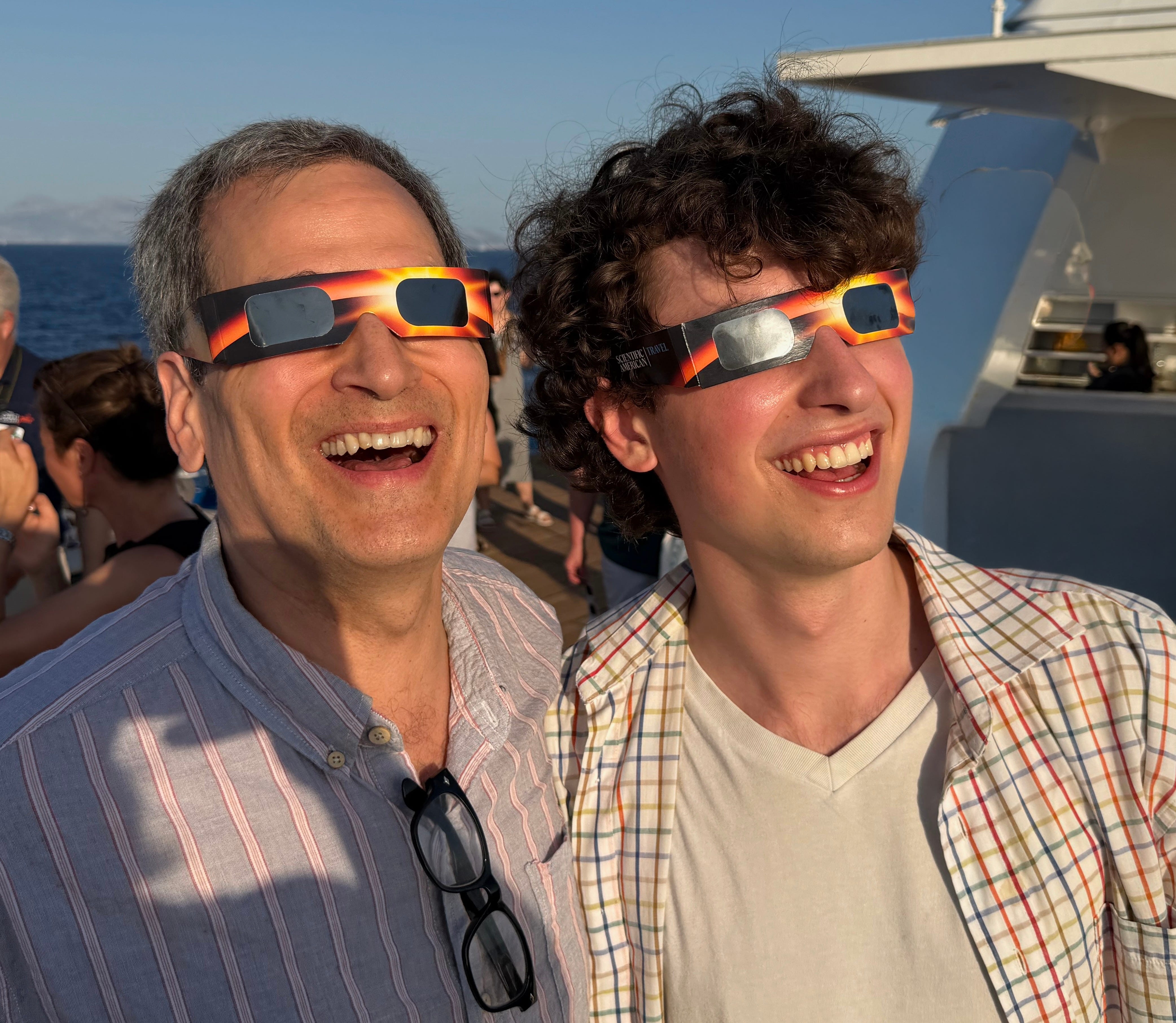
At 7:34 p.m., we all put on our cardboard safety glasses and took a look at the sun. Sure enough: There was a distinct nick in the lower-right edge of our star.
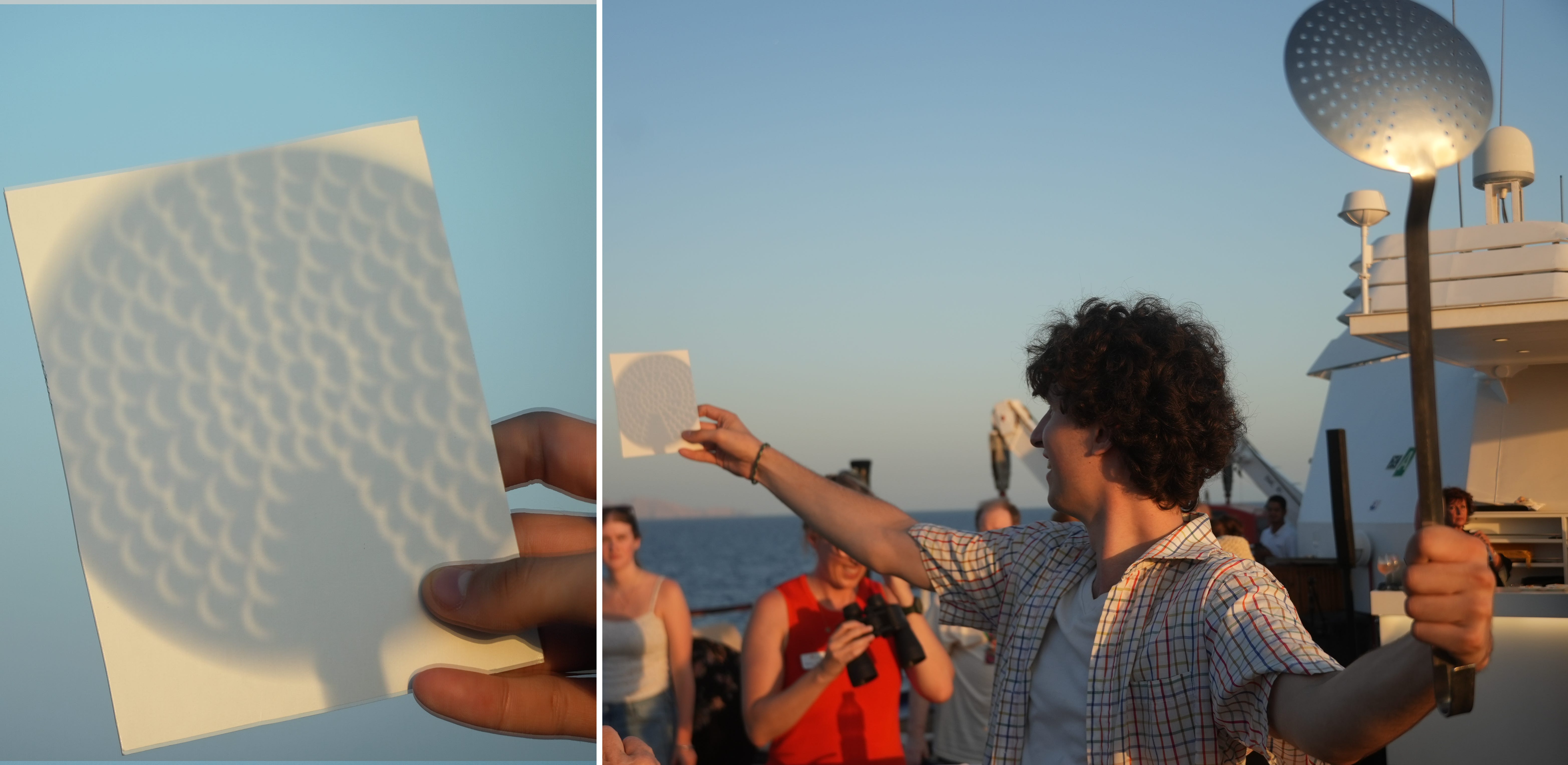
Over the next 40 minutes, the moon ate more and more of the sun’s disc. The color of light got weird. People were murmuring. Our guides offered us kitchen colanders, whose small holes acted as pinhole cameras, projecting dozens of tiny crescents.
Finally, at 8:15 p.m., the moon’s silhouette snapped like a lens cap over what was left of the sun. Now, only while the sun was completely covered, it was safe to remove the glasses and look directly at the shocking sight in the sky.
It was beautiful, alarming, freakish. People gasped, cheered, cried, and held hands.
Through my camera lens, I spotted something truly extraordinary: a brilliant red loop of plasma—a prominence—jutting from the left side of the sun. “We never get that lucky,” astronomer Dimitri Psaltis told us.
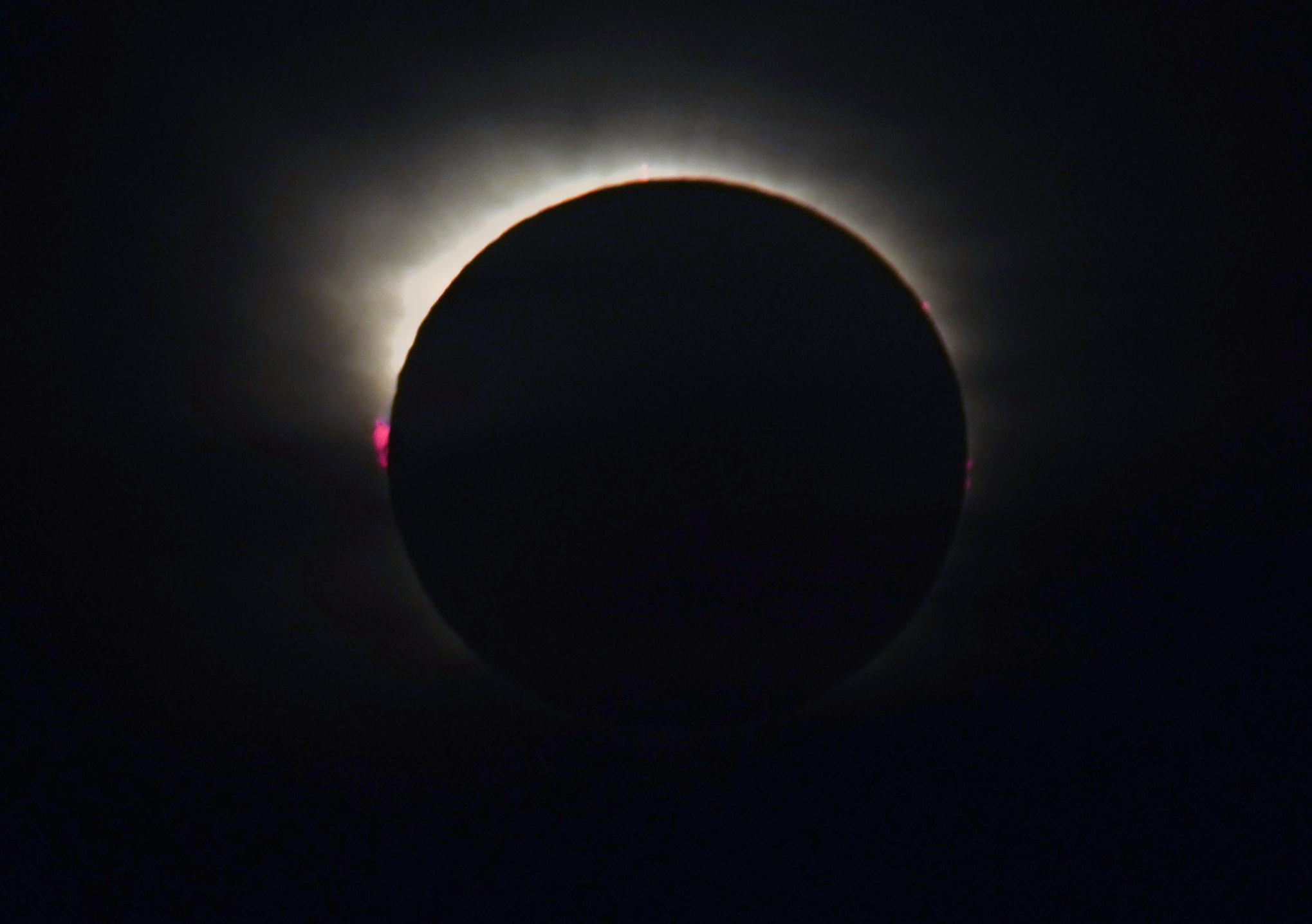
And then, after less than two minutes, the moon continued its journey, moving to the upper left, re-revealing the sun. The world’s colors faded back in. The evening heat returned. Someone put “Here Comes the Sun” on the ship’s speakers; there was dancing.
I had set up my iPhone to capture a crowd shot of the entire eclipse. Here it is, 35 minutes time-lapsed down to 20 seconds:
People were elated. They checked their cameras, babbled with their families, wiped tears from their eyes.
Nobody seemed to realize that an even bigger stunner was yet to come.
Eclipseset
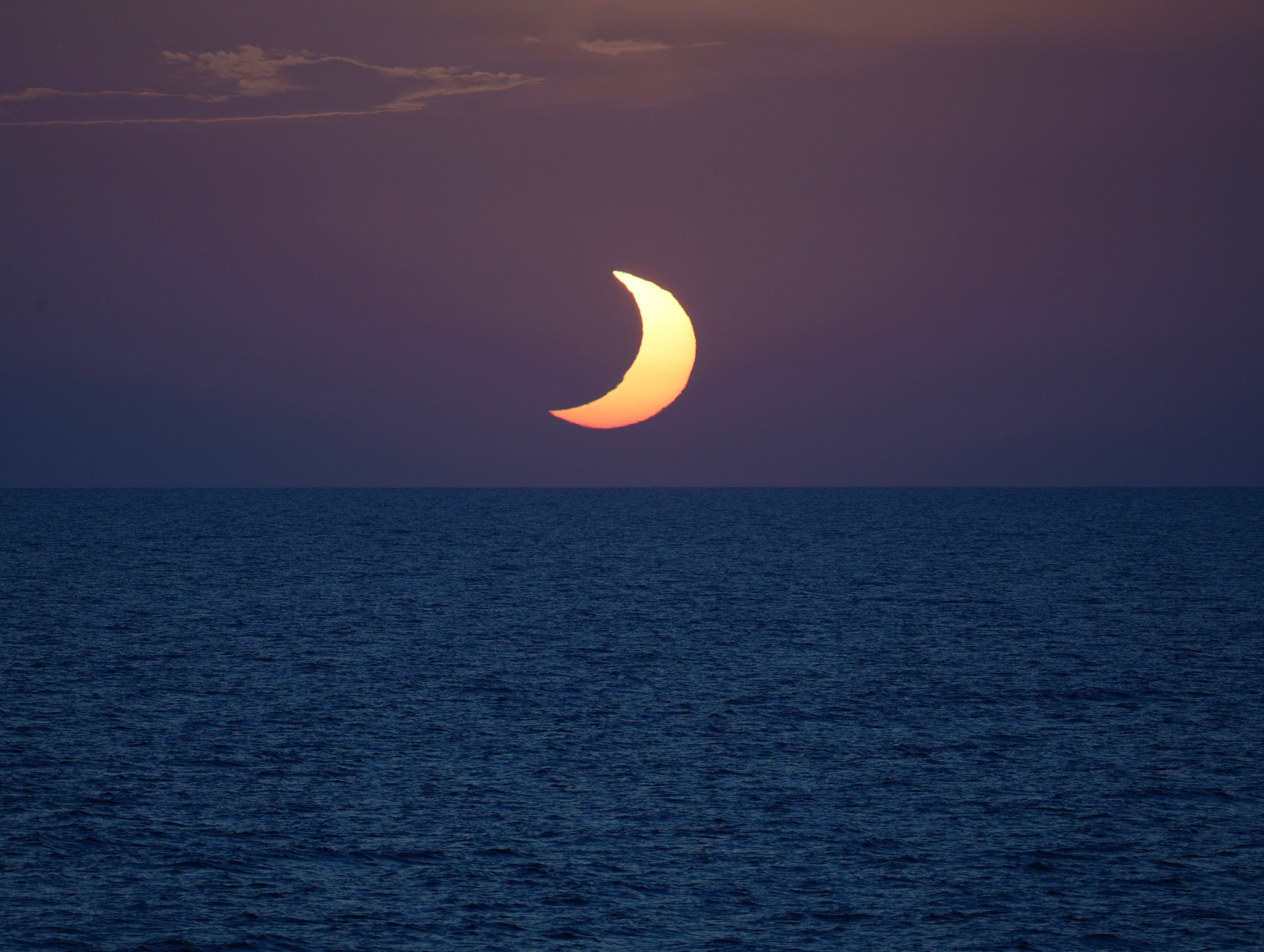
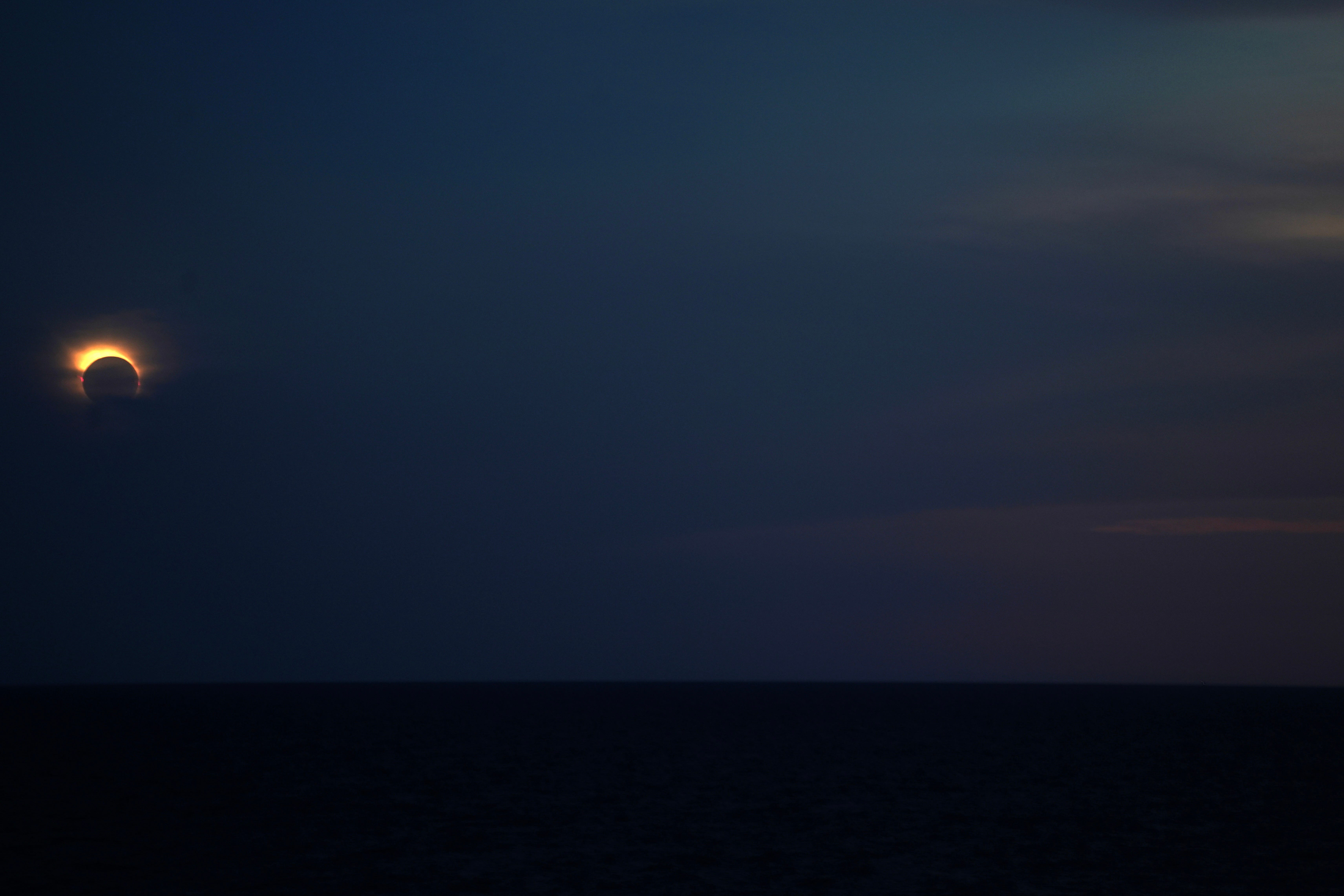
At about 8:34 p.m., someone shouted and pointed to the horizon. The sun, as scheduled, was setting into the sea, luminous and orange—but it was still eclipsed.
We were witnessing what’s known as a horizon-proximity totality: a sunset eclipse.
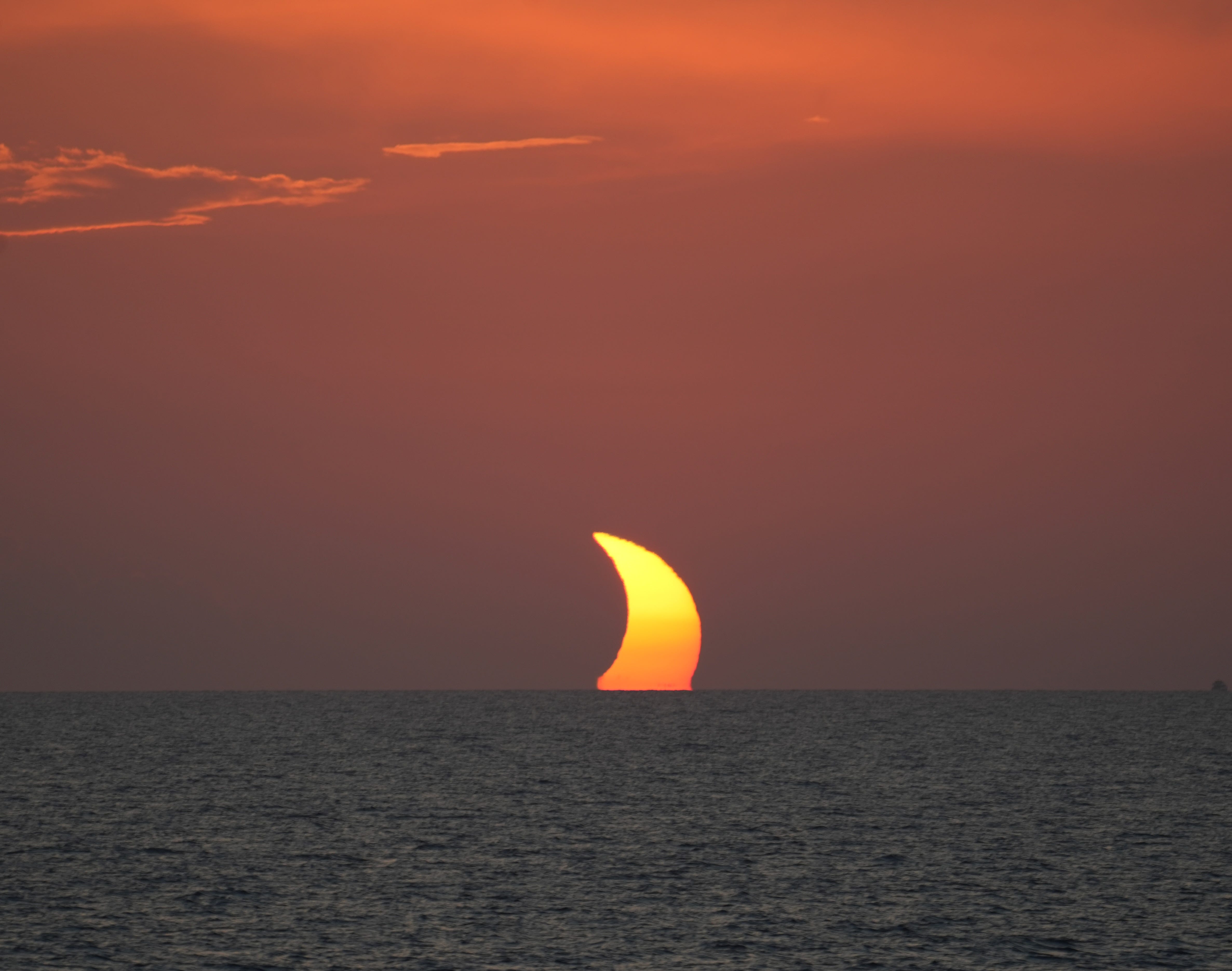
The moon’s silhouette was now color-matched to the sunset sky—but the sun’s corona was fiery yellow. It was heart-stoppingly beautiful and weird.
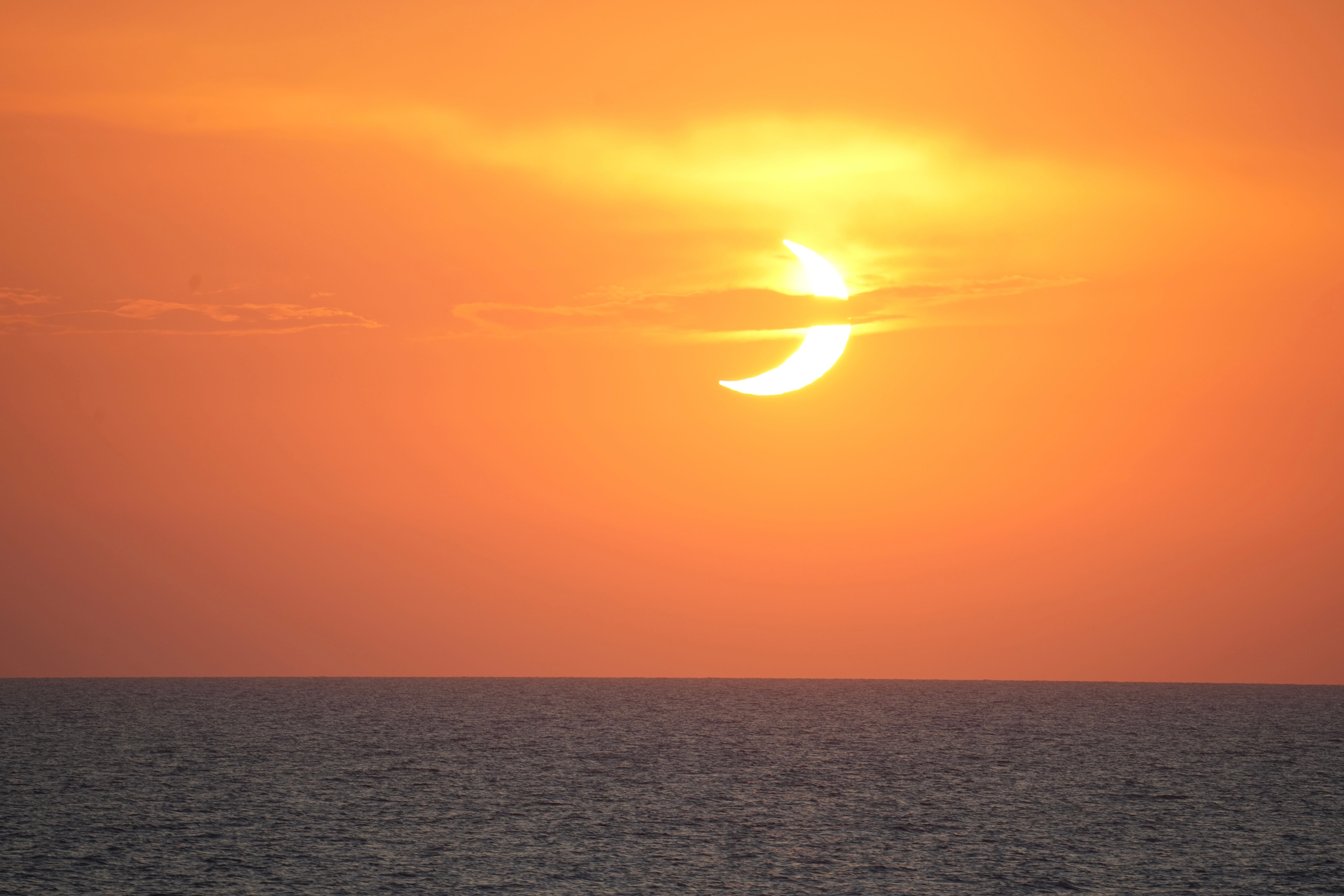
Nobody on that ship had ever seen such a thing, because a setting crescent sun is astonishingly rare. It requires an improbable collection of conditions: the already rare eclipse geometry, perfect geographical positioning, and clear weather all the way down to the horizon.
We stood at the ship’s rail, most of us incapable of speech. It looked like a magnificent lava sail, or a neon shark fin, or a still from a Christopher Nolan movie.
Peak Perseid
We stood on that ship’s deck for another hour. There was dancing, hugging, a lot of AirDropping photos.
We’d already been spoiled by two freak coincidences—the celestial alignment itself, and the crescent sunset—but incredibly, the spectacle of the sky still wasn’t over. August 12 also happened to be the peak night of the annual Perseid meteor shower, in which our planet passes through the dust and debris left behind by the Swift–Tuttle comet, producing a spectacular night of shooting stars.
By definition, a solar eclipse means a new moon (that is, no moonlight). So this would be an ideal night for viewing the meteors; Psaltis told us that we could expect to see 50 to 100 shooting stars an hour.
We lay down on yoga mats and pillows. The captain turned off all the ship’s lights. Our eyes adjusted. Soon, we were looking up at thousands of bright white stars in the jet-black sky. (Much to the annoyance of the astronomers, we also witnessed dozens of Starlink satellites gliding across the sky.)
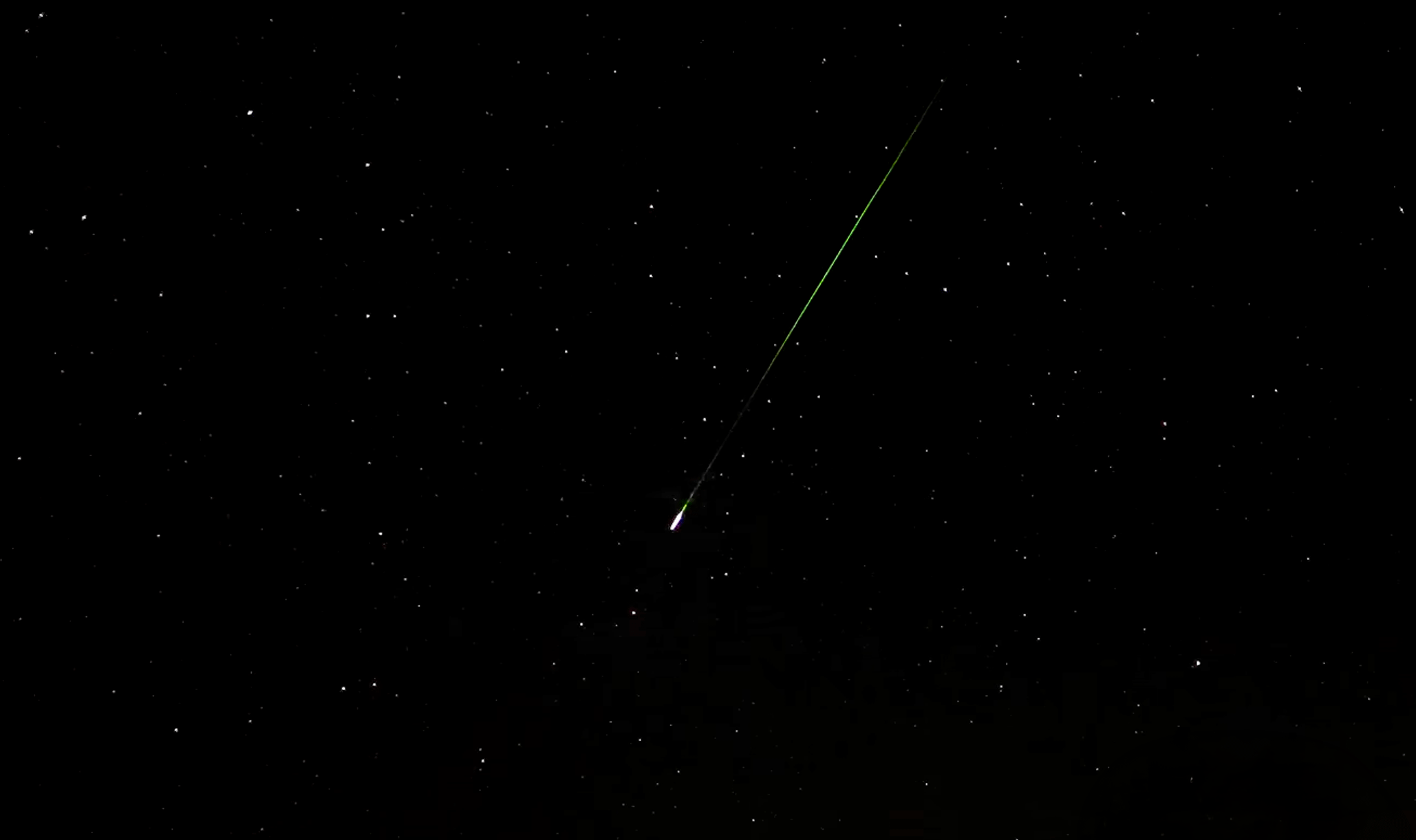
We didn’t have to wait long. These were not blink-and-you’ll-miss-it flickers. Some of these shooting stars flamed for seconds, seeming to cross half the dome of the sky.
Movies have trained us that breathtaking spectacles are always accompanied by sound effects or music. So the absolute silence of these brilliant sky zippers made them all the more eerie.
This YouTuber watched the Perseids from England, and edited together a few of the shooting stars he caught; it should give you some idea.
Sailing home
Three times in a single night, we’d witnessed mind-frying light shows in the sky. Three times, we’d stopped breathing and tried not to blink. Three times, it had been impossible not to feel infinitesimal, spiritual, and part of the cosmos.
Soon enough, we’d be back in the real world, back among our same old problems, conflicts, and routines.
But we would not be the same. That night of profound, perspective-changing awe, those three new scraps of experience, had changed us.
I hope to hold onto this feeling forever.
If not, there’s always Alaska 2033.
Thanks for this David. I was fortunate to join my brother and his family in Temple, Texas for the April 2024 Total Eclipse. In a populated area, the eery thing that happened with the totality is that the headlights of cars came on! While I can't upload pics here, I got my eclipse glasses from the Planetary Society, so nice to see the bow tied Bill Nye staring back at me. We traveled to Austin, TX to escape the more cloudy northeast and midatlantic where we live. The day in Temple had some clouds, but they didn't get in the way of the totality. Another virtue of this location was an incredible BBQ joint called Miller's Smokehouse in Belton. So after the eclipse, we had a delicious Tailgate BBQ meal! Best, your pal Jonathan Bernstein
I remember viewing a partial eclipse as seen in San Francisco years ago. What stuck me as strange was the birds got so quiet. I figured they were smarter than me and understood it better.
Perhaps like you they were in awe of the spectacle.
Cheers, kkb